Showing posts with label Social Skills. Show all posts

Wednesday, October 9, 2019

Boardmaker Online


The item of interest I want to share is a multi-level approach website that is mainly utilized for the special education classroom, however, offers benefits to all educators and service providers. The website is https://goboardmaker.com/. Boardmaker online is an online resource that allows you to create, search and support interventions in place through visuals. Beyond the creation of visuals, boardmaker online also serves as a gateway to other resources. The boardmaker online website provides links to additional hands on games, manipulatives and actives that are evidenced-based practices, particularly relating to Applied Behavior Analysis (ABA).

Boardmaker also allows you to address behavior, and mental health services in a multi-level approach from of the school social work practice mode by creating or finding documents from the website that monitor progress and evaluate service effectiveness. Boardmaker can be an assistant to collecting data and tracking student progress towards IEP goals and educational standards.

Individuals with disabilities learn and manage their world better when visual strategies are used to support their, understanding, expression, and positive behavior.  Visual strategies encourage communication, emotional regulation, learning, and independence for our students. The visuals from Boardmaker also help with organization and structure for students who either struggle with organizational skills or require organization.

I have utilized Boardmaker to create data tracking documents, behavior charts, emotion cards to help students communicate, visual task cards to keep students on track, graphic organizers, visual schedules for school and home to ensure services are being implemented in all settings, and social stories to encourage positive behavior.

Boardmaker is not free however since this resource can be used by ELL teachers and general education teachers I would highly recommend advocating for access. This resource has been used by ELL and Gen. Ed. teachers by creating word walls that are visuals cards with sight or vocabulary words to help the students create sentences.


Prices:

Personal: 1 month/$9.99, 1 year/$99, 2 years/$190, 3 years/$270

Professional: 1 Month/$19.99, 1 Year/$199, 2 Years/$360, 3 Years/$540

District: Call for pricing (800) 588-4548


Free resource that offers premade visuals: http://www.victoriesnautism.com/communication--behavioral-cues.html

Tuesday, December 4, 2018

Social Stories

https://carolgraysocialstories.com/social-stories/what-is-it/

My item of interest is Social Stories. My supervisor asked me to start writing some stories for one of the student's on the case load with autism. The goal for this particular student was helping him to understand how to work with others. However, social stories can literally be used for anything social skills related. It is a great tool when you need to appropriately introduce students to concepts they are unfamiliar with. I think it is very beneficial for the elementary/ middle school age, but of course can be used for high school age students as well.  The website does give several examples of social stories, which I found helpful when writing my own. The topics the website has examples on are, safety, tragedies, discovery of self and others, and advanced concepts like stereotypes.

Sunday, November 5, 2017

Matt and Molly Social Skills

Matt and Molly Social Skills Curriculum

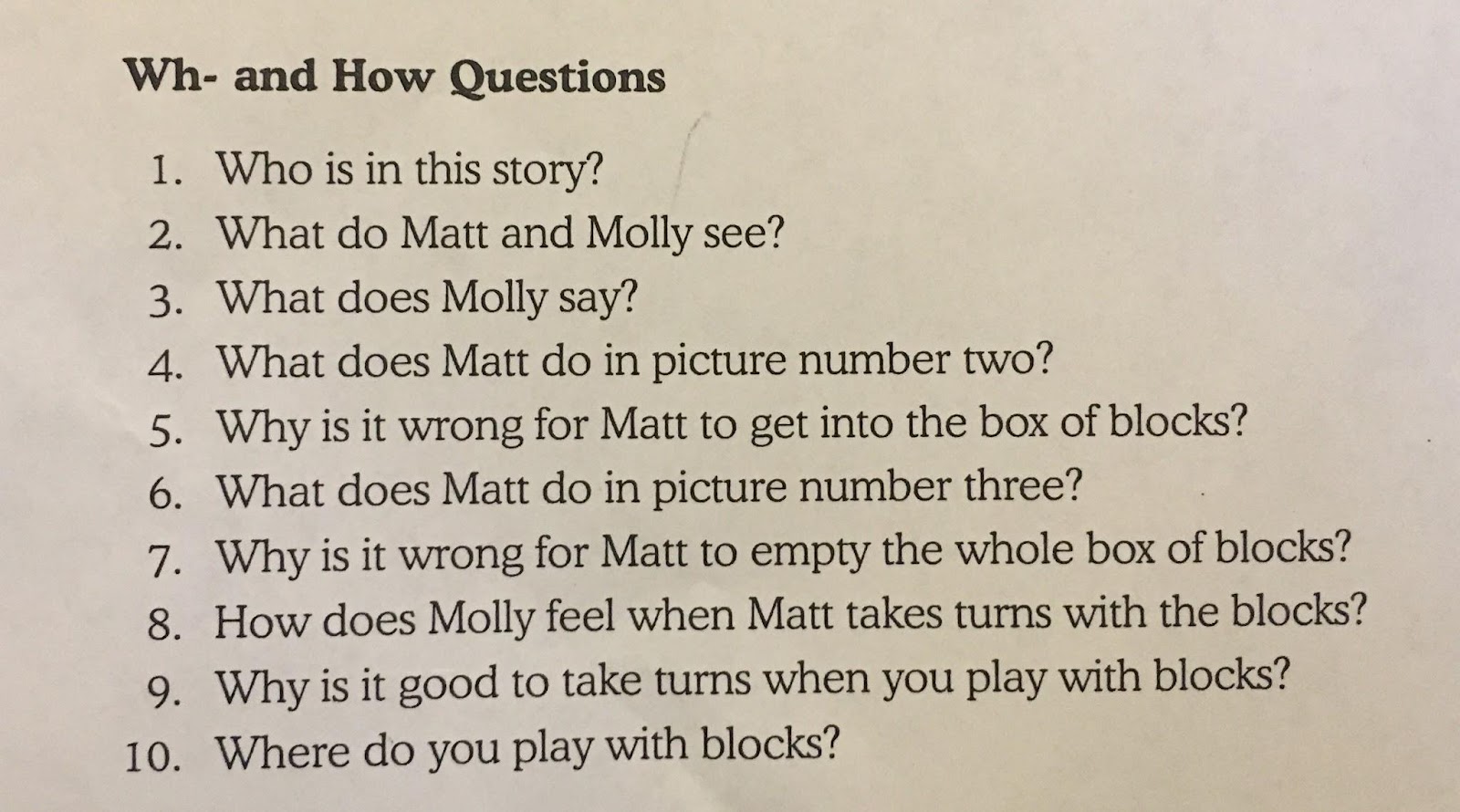
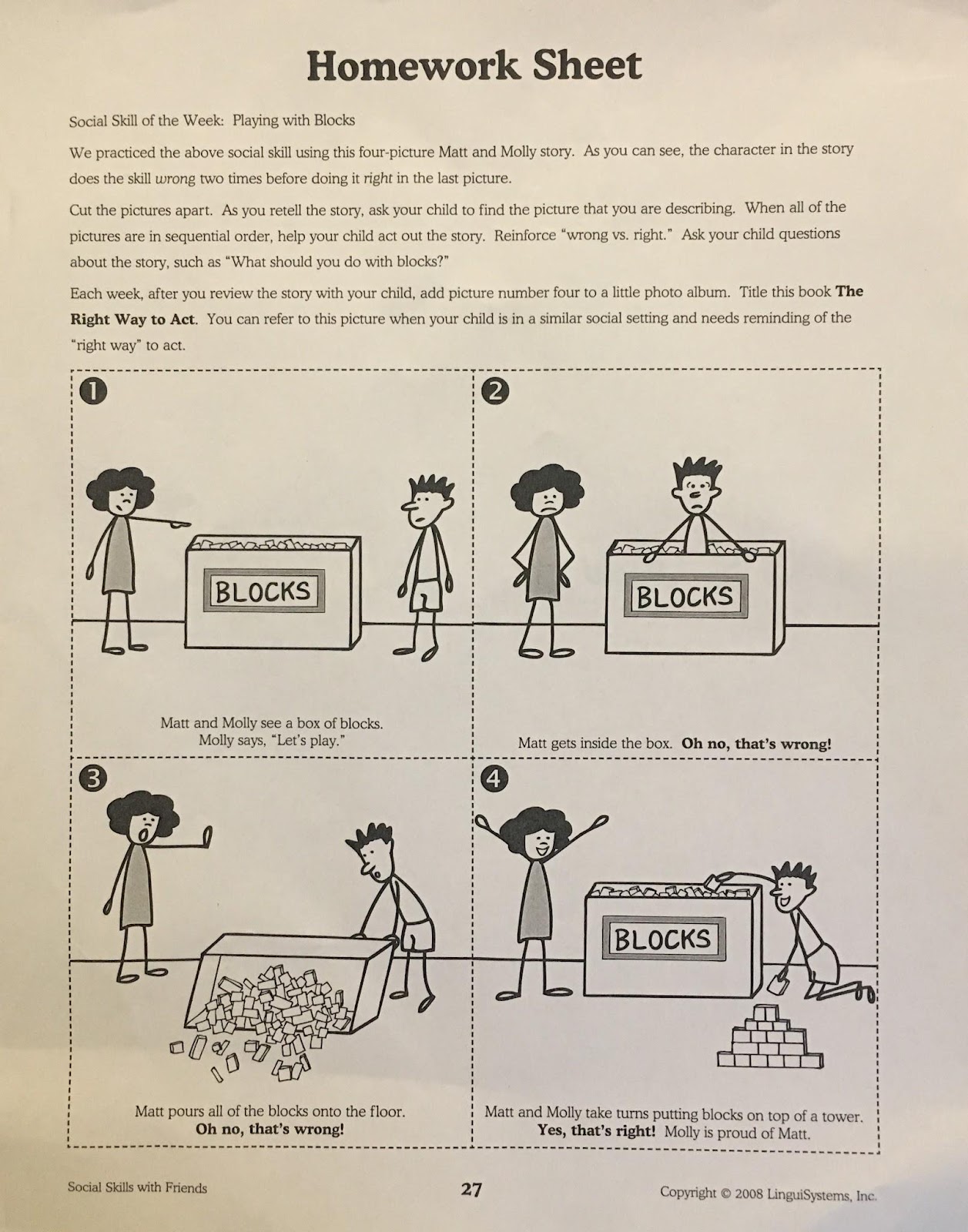
The Matt and Molly Social Skills Curriculum teaches young children different social skills through the use of a 4 sentence story. The curriculum was created to be used to teach children on the Autism Spectrum, different social skills. Each story contains four different cards with a picture on each. Each picture has one sentence that goes along with it. As the facilitator shows the students the picture, he/she also reads the sentence that goes along with that picture. The students are then given a variety of questions related to the story. Depending on the skills of the students you are working with, you can use either the yes/no questions or the wh/how questions that are provided. The social worker at my placement and I, use the curriculum for two special education early childhood classes. One of the classes is lower functioning, therefore we ask them the yes/no questions after each story. The second group of students that we work with are more advanced, therefore we use the wh/how questions with them. The questions allow the students to discuss what they learned throughout the story and recognize the social skill that was taught.  
After each story, we have the students participate in an activity related to the story. After this particular story, we had the students practice the skills of turn taking and playing together, by building a tower out of blocks together. This curriculum is one that is very easy to facilitate and really engages the students. I believe that this curriculum can also be used for general education preschool and kindergarten students.

Title: Matt and Molly Play with Blocks
Skills Learned: Turn Taking & Playing with Peers
IMG-5773.jpg IMG-5775.jpg
IMG-5776.jpg IMG-5777.jpg

IMG-5779.jpg
IMG-5780.jpg

IMG-5778.jpg

Thursday, December 8, 2016

Group Exercises for Enhancing Social Skills & Self-Esteem


Group Exercises for Enhancing Social Skills and Self-Esteem is a collection of activities and therapeutic exercises to assist in group work. The worksheets were created to help a wide range of individuals, including those who display symptoms of depression, ADHD, developmental disabilities and general social skill deficits with improving their social skills. The goal in mind is to enhance feelings of well-being and positive self-esteem. These exercises can be used in all types of group work settings.

The skills that group members can acquire through these exercises should serve them in their day-to-day social environments. The exercises should stimulate group members to expand their knowledge, explore values and beliefs, challenge creative thinking, and safely consider change for personal growth.

 Reference

Khalsa, S. S. (1996). Group exercises for enhancing social skills & self-esteem. Sarasota, FL: Professional Resource Press.


Sunday, November 20, 2016

Social.Skills.Autism

Social Skills with Students that have Autism
            For the past month I have been observing and participating in a social skills group with students that have autism.  The school social worker conducts the group with the entire class.  The teacher and the two teacher aids also assist the school social worker to run the group.  The purpose of this group is to help students with Autism build social skills.
A few weeks ago I participated in a social skills activity that appeared to engage the students.  The activity came from the electronic book Building Social Skills (2006) written by Danny Pettry.  What I liked about the activity is it helps people with Autism to make a connection between words that are related to social interaction.  Since students with autism struggle with understanding sensory information this activity helps them to understand the meaning of the words they hear from others.  What was also fascinating to observe was once the students understood what social skill the group leaders wanted them to demonstrate they could then complete the task. 
When referencing the National School Social Work Practice Model, this activity falls under the practice feature of implementing evidence based education, behavior and mental health services.  Though I have been in the group for only a few weeks, the school social worker has debriefed with me regarding student progress.  Specifically, when discussing outcomes, she identified two students that were non-verbal last year.  Both of these students can now respond to questions from teachers which is a measurable outcome.  Though those two student’s progress cannot be directly connected to the social skills group, as previously stated, the students could demonstrate the social skill the group leader was asking them to complete once they understood what task they were being asked to accomplish.          


References
Pettry, Danny. (2006). Building Social Skills through Activities. Retrieved from 

Saturday, November 5, 2016

Social Thinking: Chicago Metro Conference


Social Thinking Conference 
April 24-26

Social Thinking presents: Chicago Metro Area Conference

April 25-27, 8:30-3:45 PM


Conference led by a speech language pathologist, Michelle Garcia Winner, will also include other presenters. Organization that helps people develop their social competencies to better connect with others. They teach different skills and strategies that can be used in the classroom, home or community centers to help students with organizational skills and social emotional learning.

What is social thinking? Social thinking is the process by which we interpret the thoughts, beliefs, intentions, emotions, knowledge and actions of another person along
with the context of the situation to understand that person’s experience.

Topics Conference will cover:
Executive functioning: Tackle Homework and classwork with these helpful strategies!
(5th graders – young adult)
Learn organizational skills, strategies to find motivation to tackle tasks, and strategies to complete homework.

Zones of regulation: A framework to foster self-regulation and emotional control (K-Young adult)

Learn the frameworks for self-regulation and emotional control, and executive functioning. It is a cognitive behavior approach that uses four zones (colors) to help students visually and verbally self-identify how they are functioning in the moment given their emotions and state of alertness.


Helping teens prepare for the real adult world (upper elementary – young adult).
This conference focuses on helping parents and educators prepare for and learn how to respond to the transition to independence. Discuss strategies that will help individuals develop a more mature social mindset.

The frameworks and strategies taught in these courses are developed from
Using peer-reviewed research and client family values. Also, it connects to research in fields that study how individuals have evolved and developed in order to function in society like: anthropology, cultural linguistics, social psychology, child development etc. 

This conference fits in the Promote a school climate and culture conducive to student learning and teaching excellence section of the School social work model. It is allowing the enhancement of professional capacity of school personnel by providing them with an opportunity to further their knowledge on social emotional and executive functioning skills that could be applied within special education classrooms.  


Link to Brochure: Brochure