Showing posts with label Mental Health. Show all posts

Wednesday, October 23, 2019

Child Mind Institute


Child Mind Institute

The item of interest I chose is a website dedicated to mental health disorders and concerns that children and adolescences may encounter. The website is the Child Mind Institute (https://childmind.org/). The Child Mind Institute (CMI) is based out of New York. CMI conducts various research students on mental health issues that occur in children and adolescences.at any given time CMI has multiple clinical studies going on that are led by their vast multi-disciplinary teams. For example, they currently have two different studies related to autism occurring. One is Neuronal Correlates of Autism in ADHD and Autism and the other is Brain and Behavioral Changes Over Time in Young Children with Autism. Also, within the vast realm of research conducted by CMI, they also have a platform called Data-Sharing & Open-Source Initiatives where the researchers for CMI freely and openly share their data as they obtain it instead of withholding it for publication.

In addition to research, CMI offers access to a plethora of other resources some of which include:

·       Topics A-Z (https://childmind.org/topics-a-z/)
o   Provides information about disorders, concerns, medications and basic facts about disorders children can have.

o   Resources for parents, educators, and practitioners to use to not only gain a better understanding and to identify signs of disorders and concerns in children but also how to better support children with different disorders.

·       Blogs & Articles (https://childmind.org/topics-a-z/brainstorm-blog/)
o   Provides information about different disorders, concerns, and current factors that can influence or relate to the mental health of children.

o   Offers curriculum for schools and communities as well as webinars for educators, parents, and professionals. Some resources may cost money.

·       Ask an Expert (https://childmind.org/topics-a-z/ask-an-expert/)
o   Provides an FAQ format with questions that other parents have had about their children with different mental health disorders that are answered by the multi-disciplinary team at CMI.

·       Symptom Checker (https://childmind.org/symptomchecker/)
o   Survey platform where parents can check off different items that relate to their child’s behavior. Gives insight into what their child might have but does not diagnose any disorders.

·       Project UROK (https://childmind.org/our-impact/project-urok/)
o   Online platform that allows children with mental health issues to share stories, videos, and to gain support from others with mental health issues. UROK was designed to help de-stigmatize mental health issues through encouraging others to share their stories.

Although this is not an exhaustive list of the resources or information that is provided through the Child Mind Institute, these are resources that I found to be unique and potentially beneficial. The information and resources provided through this website allow for anyone on it to gain better insight into the diverse mental health disorders and concerns that children and adolescences face. I think that this website is a great tool to have in our toolbox as school social workers as we could share the information on it with our fellow educators at our schools and with the parents of the students that we work with. This website could be especially useful to share with parents who may not have a deep knowledge of mental health disorders in children. Parents and children alike could utilize this website to gain a better understanding of disorders especially if a student is being evaluated for special education services (IEP or 504). With this website in our toolkits, we can continue to partake in the home-school-community linkages that are a part of the school social work practice model (Villarreal Sosa, Cox, & Alvarez, 2017).

Please explore this awesome website! https://childmind.org/

References
Villarreal Sosa, L., Cox, T., & Alvarez, M. (2017). School Social Work: National Perspectives on Practice in Schools. New York: Oxford University Press. ISBN: 978019027842.

Thursday, September 26, 2019

Calm Guided Meditation

Calm is a guided mindfulness and meditation app that can be used in a lot of different ways.  Each day has a daily calm that provides the user with a focus on how to be more mindful and helps guide the user into recognizing times that cause stress.  Most of the meditations are about 10 minutes but you are able to find ones that are shorter or longer depending on your needs.  There are also different programs for things like sleep, anxiety, stress, self-care, focus, etc.  There are different practices that last between 7 to 21 days that focus on different needs as well which I thought could be helpful for a student or an educator who might be facing certain challenges.  Other features include music that is calming or energizing that lasts a few minutes or over an hour, a collection of sleep stories to help individuals with anxious minds work on their sleep hygiene, and short stretches and yoga moves to help relax the body.  
I believe this practice would be helpful to use in sessions or groups with students because it has been shown to be effective and is fairly simple to practice.  It helps with feelings of disappointment or overwhelming experiences.  Mindfulness has been used with students with ADHD and Autism as well as anxiety, depression, and behavioral challenges. Mindfulness can be used as an empowerment tool for students and help them regulate emotions and build resilience in tough situations.  The creators of Calm state that using mindfulness can help students regulate emotions better, be more alert during learning, have better attention to the task at hand and respond better to the needs of other students. The application has a seven-page instruction manual on how to implement this practice in a school setting as well.
This website has a few options for access, one is limited access which is free to all users.  The second option is that an individual can pay for an annual membership of $59.99 or a lifetime membership for $399.99.  However, there are two options for school social workers, you can sign up through calm health and get a free yearlong subscription for being a social worker or you can sign up through calm schools and get a lifetime membership for free, you just have to get approved.  It can be accessed through your computer, android, or iPhone.  

You can access this website by downloading the app on your iPhone or Android, or by going to: www.calm.com 

Monday, October 29, 2018

Social Worker Toolbox

While doing some research I came across this website that I thought had some good resources.  There are different resources, activities and education material for students and their family.  Topics include alcohol use,  bullying, mental health (depression, suicide, anxiety) self harm, domestic violence, parenting, social emotional skills and so much more.  Curriculums, planning and intervention handouts and assessments are also provided to use. Website also includes books suggestions on various topics such as grief and loss, bullying and adoption.  The website provides resources for so many topics that I suggest you check it out!


http://www.socialworkerstoolbox.com/

Sunday, November 6, 2016

Social Stories

What is a Social Story?

_________________

Social Stories are a social learning tool that supports the safe and meaningful exchange of information between parents, professionals, and people with autism of all ages. The people who develop Social Stories are referred to as Authors, and they work on behalf of a child, adolescent, or adult with autism, the Audience.

Authors follow a defined process that begins with gathering information, discovering a topic that ‘fits’ the Audience, and the development of personalized text and illustration. Most frequently associated with short, simple Stories, there are also Social Articles for use with older or more advanced individuals. The Social Story Definition and ten defining characteristics (The Social Story Criteria) guide the development of every Story and result a patient, respectful, and unassuming quality that is the hallmark of the approach. It is that quality that distinguishes genuine Social Stories from social scripts, skill checklists, or ‘social stories’ that do not meet the current the definition.

There is only one definition for the term ‘Social Story’:

A Social Story accurately describes a context, skill, achievement, or concept according to 10 defining criteria. These criteria guide Story research, development, and implementation to ensure an overall patient and supportive quality, and a format, “voice”, content, and learning experience that is descriptive, meaningful, and physically, socially, and emotionally safe for the child, adolescent, or adult with autism.

How are Social Stories Used?


  • Safety: Understanding safety may make it easier to follow some rules.
  • Tragedies:  What a tragedy is and understanding tragedies on television.
  • Discovery of Self and Others:  Each person is one of a kind.
  • Advanced Concepts: Stories to address ‘elusive’ topics like stereotypes and resilience.
  • Change: Changes in their daily life, including transitions. 


Additional Social Story Information:

Where did Social Stories come from?
The History of Social Stories

Is THIS a Social Story?
It is NOT a Social Story if… An initial screening instrument

How the Social Story Criteria keep pace with experience and research
Social Stories 10.0 – 10.2 Comparison Chart

Wednesday, September 28, 2016

....But I Don't Want to Go to School!


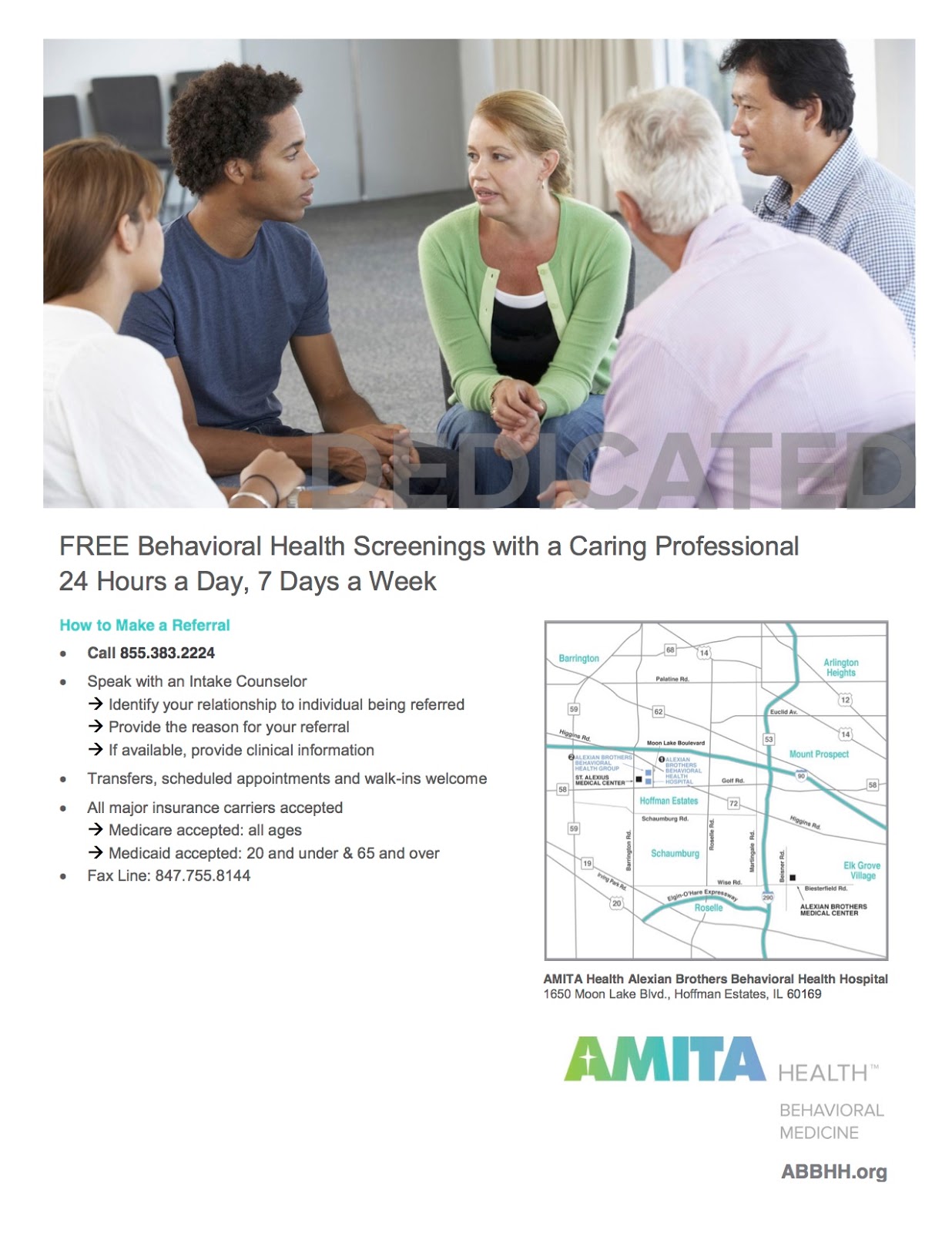
AMITA Health Alexian Brothers Behavioral Health Hospital
1650 Moon Lake Blvd., Hoffman Estates, IL, 60169

Alexian Brothers Behavioral Health Hospital provides community services to children, adolescents, and adults on a wide range of needs. The list of services that are provided are listed at the bottom of this post. This post focuses mostly on school refusal for children and adolescents since it is a very widespread and common issue in schools. Parents are a very important part of helping their child when it comes to school refusal in order to ensure that parents do not fall into the student's ritual of not attending school or succumb to their excuses. By informing parents of these strategies listed below, they can learn how to help their child when school refusal occurs. There is also a program for school refusal that Alexian Brothers offers which included family therapy, a school liaison during the transition, and looking into other issues or disorders that could be co-occuring with their school refusal, and a 30 day follow up with the school and family is implemented.


How to Make a Referral & Insurance Information 

                           List of Services Provided (Inpatient and Outpatient)


Go to Alexian Brothers Behavioral Health Website for additional information