Showing posts with label School Refusal. Show all posts

Monday, November 13, 2017

WhyTry Program


The Why Try curriculum is a program used to help students be able to answer the question “why try in life?”.  This is used in our Social Emotional Learning groups and in helping students who are having difficulties putting effort into home, school, and peer challenges.  We use this curriculum in the high school setting but I think the activities could be directed at middle school aged students.  It can address behavioral problems, dropout prevention, classroom management, and career and college preparation.

WhyTry curriculum uses 10 analogies: Channeling Anger and Challenges into Positive Motivation, the Reality Ride, Tearing off Labels, Defense Mechanisms, Climbing Out, Jumping Hurdles, Desire Time and Effort, Lift the Weight, Getting Plugged In, and Seeing Over the Wall.  These analogies use “active learning” which means the students are actively involved in the learning process.   They see and hear the analogies, music and lyrics are involved, and hands-on experiential learning activities are used.  Visual, verbal, discussion, experience, teach and share with others, application, and internalizing are all the different learning styles used for effectiveness and retention.
This program would be used in the Social Work Model area of “provide evidence based education, behavior, and mental health services” because it is a research based program implemented in a group setting.
The website offers a free sample program, the products, access to training events, and research on the success of the program.


Sunday, November 6, 2016

Social Stories

What is a Social Story?

_________________

Social Stories are a social learning tool that supports the safe and meaningful exchange of information between parents, professionals, and people with autism of all ages. The people who develop Social Stories are referred to as Authors, and they work on behalf of a child, adolescent, or adult with autism, the Audience.

Authors follow a defined process that begins with gathering information, discovering a topic that ‘fits’ the Audience, and the development of personalized text and illustration. Most frequently associated with short, simple Stories, there are also Social Articles for use with older or more advanced individuals. The Social Story Definition and ten defining characteristics (The Social Story Criteria) guide the development of every Story and result a patient, respectful, and unassuming quality that is the hallmark of the approach. It is that quality that distinguishes genuine Social Stories from social scripts, skill checklists, or ‘social stories’ that do not meet the current the definition.

There is only one definition for the term ‘Social Story’:

A Social Story accurately describes a context, skill, achievement, or concept according to 10 defining criteria. These criteria guide Story research, development, and implementation to ensure an overall patient and supportive quality, and a format, “voice”, content, and learning experience that is descriptive, meaningful, and physically, socially, and emotionally safe for the child, adolescent, or adult with autism.

How are Social Stories Used?


  • Safety: Understanding safety may make it easier to follow some rules.
  • Tragedies:  What a tragedy is and understanding tragedies on television.
  • Discovery of Self and Others:  Each person is one of a kind.
  • Advanced Concepts: Stories to address ‘elusive’ topics like stereotypes and resilience.
  • Change: Changes in their daily life, including transitions. 


Additional Social Story Information:

Where did Social Stories come from?
The History of Social Stories

Is THIS a Social Story?
It is NOT a Social Story if… An initial screening instrument

How the Social Story Criteria keep pace with experience and research
Social Stories 10.0 – 10.2 Comparison Chart

Wednesday, September 28, 2016

....But I Don't Want to Go to School!


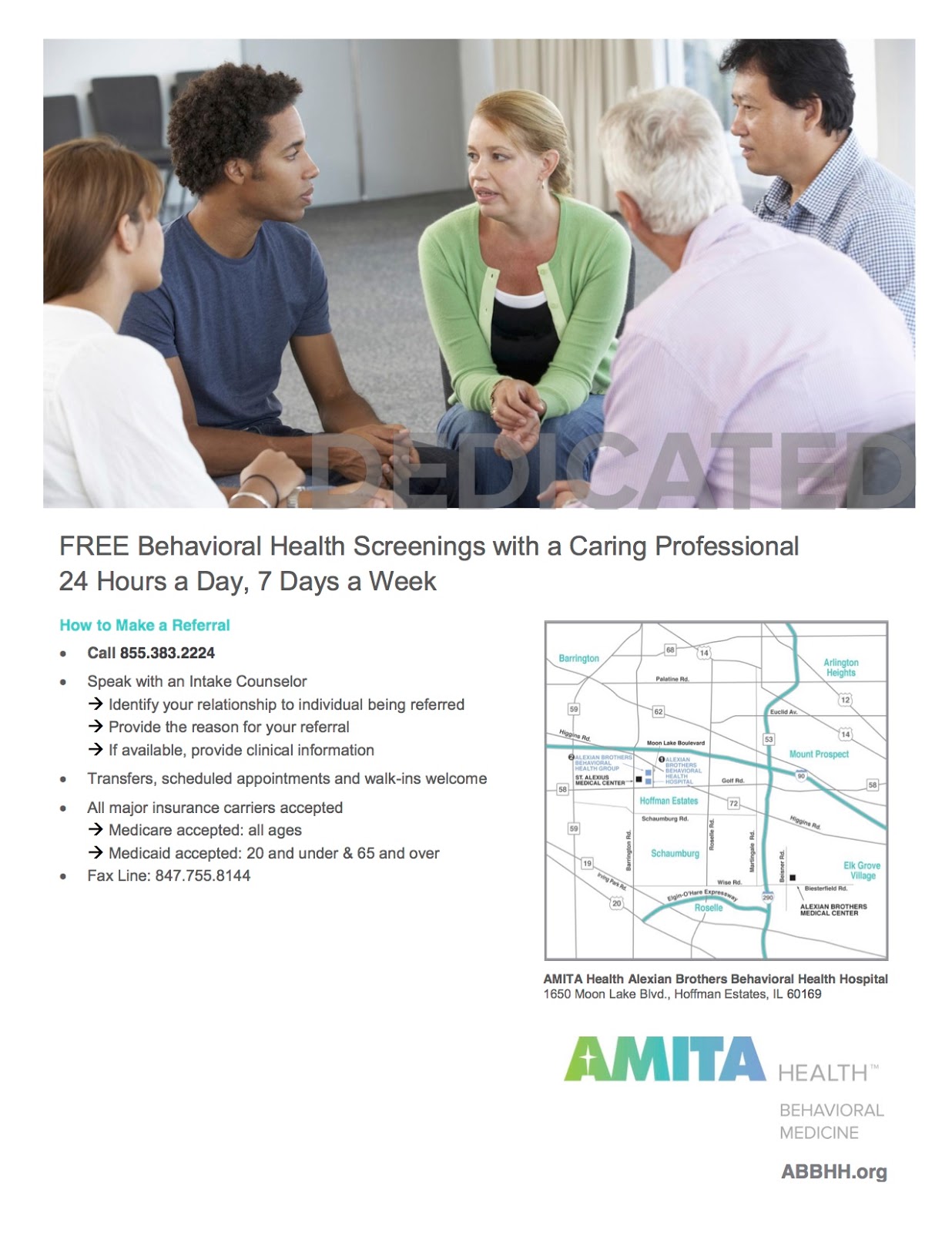
AMITA Health Alexian Brothers Behavioral Health Hospital
1650 Moon Lake Blvd., Hoffman Estates, IL, 60169

Alexian Brothers Behavioral Health Hospital provides community services to children, adolescents, and adults on a wide range of needs. The list of services that are provided are listed at the bottom of this post. This post focuses mostly on school refusal for children and adolescents since it is a very widespread and common issue in schools. Parents are a very important part of helping their child when it comes to school refusal in order to ensure that parents do not fall into the student's ritual of not attending school or succumb to their excuses. By informing parents of these strategies listed below, they can learn how to help their child when school refusal occurs. There is also a program for school refusal that Alexian Brothers offers which included family therapy, a school liaison during the transition, and looking into other issues or disorders that could be co-occuring with their school refusal, and a 30 day follow up with the school and family is implemented.


How to Make a Referral & Insurance Information 

                           List of Services Provided (Inpatient and Outpatient)


Go to Alexian Brothers Behavioral Health Website for additional information